Values Over Expectations: How to Build a Life That Actually Feels Like Yours

We’ve all been there, doing exactly what we’re "supposed" to do, yet feeling like we’re wearing a costume that’s two sizes too small.
Whether you’re a teen navigating the "Performance Script" of high school, a young adult facing the "Comparison Script" of social media, or an adult stuck in the "Should Script" of career and family, the pressure to meet outside expectations is a leading driver of anxiety.
But research shows there is a better way to navigate these life transitions. Instead of fighting to be "perfect," we can focus on being psychologically flexible.
The Science of Feeling Better: What is ACT?
Acceptance and Commitment Therapy (ACT) is a modern approach to mental health that is less about "fixing" your thoughts and more about changing your relationship with them.
While traditional therapies often focus on reducing symptoms, ACT focuses on life enhancement. It asks, “How can you live a meaningful life, even when things are hard?” According to a recent narrative review by Anusuya S. P. and Gayatridevi S. (2025), the secret lies in psychological flexibility which is the ability to stay present and move toward your values even when you're uncomfortable.
Moving from Expectations to Values
Think of expectations as a destination on a map that someone else drew for you. They are "all-or-nothing" goals; Get the "A," get the promotion, look a certain way. If you don’t reach the destination, you feel like a failure.
Values, on the other hand, are like a compass. They aren't things you "check off" a list; they are directions you choose to head in every single day.
An expectation, "I must be the most popular person in my grade." (External/Rigid)
A value, "I want to be a kind and reliable friend." (Internal/Flexible)
6 Tools to Help You Live for You
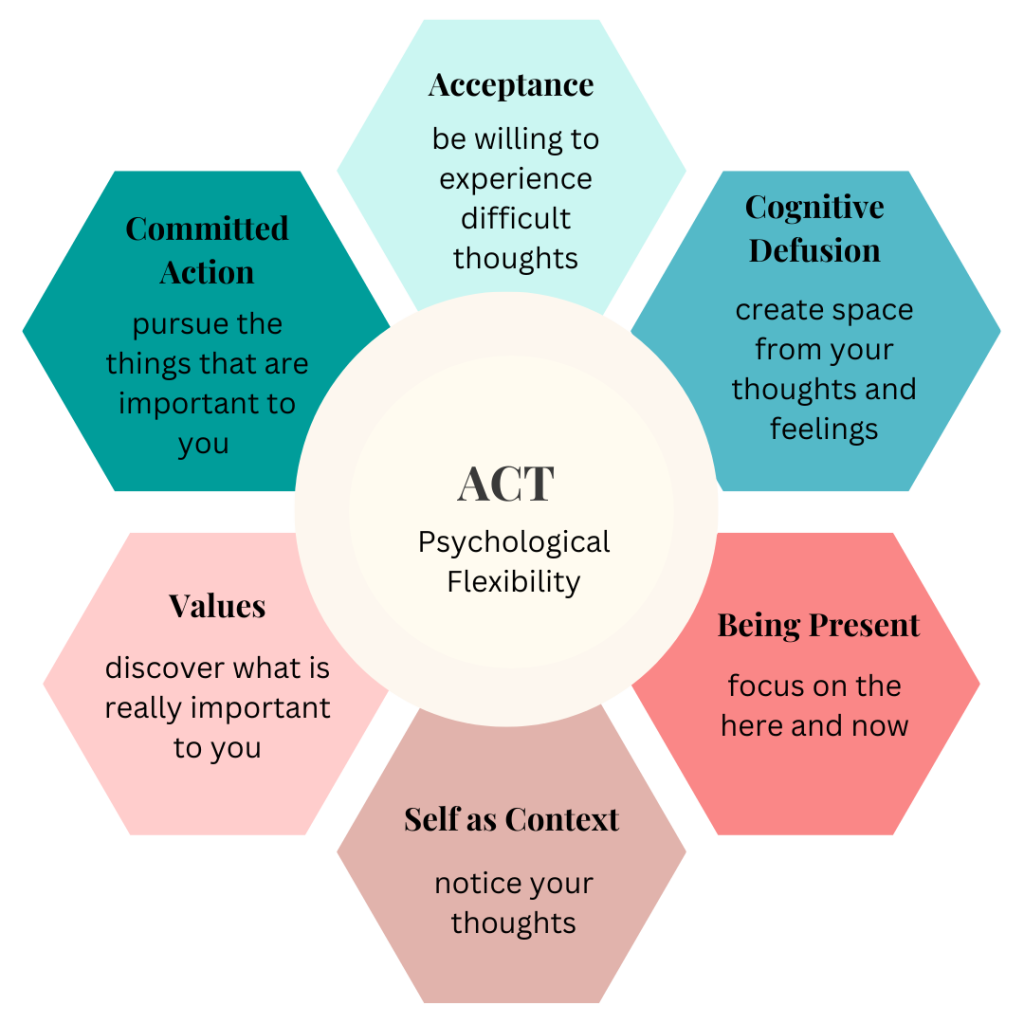
Based on the core processes of ACT, here are six ways to shift from living for others to living for yourself:
Credit: Health and Healing Therapy
Acceptance: Instead of fighting your anxiety or trying to “get rid of” bad thoughts, try opening up to them. They are a natural part of the human experience.
Cognitive Defusion: Your thoughts are just words and pictures, not literal truths. If your brain says, "I'm a failure," try saying, "I'm having the thought that I'm a failure." This creates space between you and the thought.
Being Present: Use mindfulness to stay in the "here and now." When we worry about expectations, we are usually living in the future. Come back to your breath and the room you're in.
Self-as-Context: Remember that you are the "container" for your thoughts and feelings, not the thoughts themselves. Your identity is much bigger than any one emotion or mistake.
Values Clarification: What actually matters to you? Not your parents, your boss, or your followers, but you. Is it creativity? Adventure? Helping others?
Committed Action: This is the most important step. It means taking a small, real-world action that aligns with your values, even if you still feel nervous.
Why This Matters for Every Generation
For Teens: Understanding that you don't have to "fix" your feelings before you can do what matters is a superpower. It helps reduce experiential avoidance (trying to escape hard feelings), which is a major cause of distress.
For Young Adults: As you move through major changes, using your values as a compass helps you make decisions that actually feel like yours, rather than just following the crowd.
For Adults: ACT helps move us away from "environmental mastery" (trying to control everything around us) and toward "personal growth" and self-acceptance.
The Foundation of Value
A life built on expectations is a house of cards. A life built on values is a foundation you can actually stand on. By practicing mindfulness and choosing values-driven actions, you aren't just surviving anxiety, you are building a life of purpose.
Reference:
P, A. S., & S, G. (2025). Acceptance and Commitment Therapy and Psychological Well-Being: A Narrative Review. Cureus, 17(1), e77705. https://doi.org/10.7759/cureus.77705